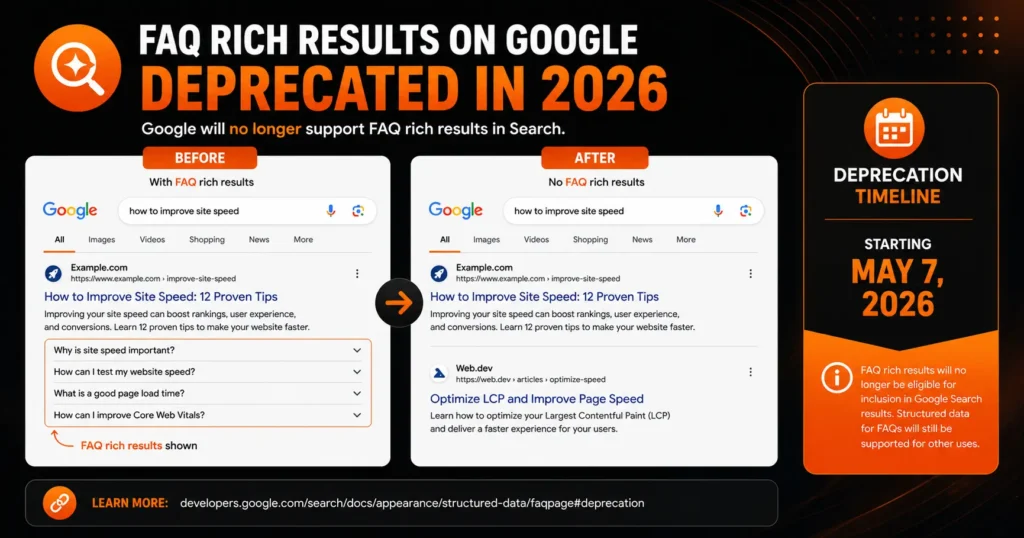
On May 7, 2026, the Google FAQ rich results 2026 deprecation became official — quietly updated in Search Central documentation with No blog post, No announcement. Just a deprecation notice sitting at the top of the FAQ structured data page that read: “FAQ rich results are no longer appearing in Google Search.”
For most SEOs, the reaction was a shrug and a checklist update. Delete the schema, move on.
That’s the wrong read.
This change is the end of a chapter that started with a bang in 2019, slowly contracted through 2023, and finally closed completely last week. But more importantly, it’s a signal — one that points directly at where search visibility is actually moving in 2026. And if you’re still optimizing for the SERP of three years ago, you’re already behind.
Let’s break down exactly what happened, what it means for your site right now, and what you should actually do about it.
If you’re working with an SEO services in Lucknow partner or managing SEO in-house, this update affects your reporting workflow starting June 2026.
Table of Contents
A Brief History: How FAQ Rich Results Rose and Fell
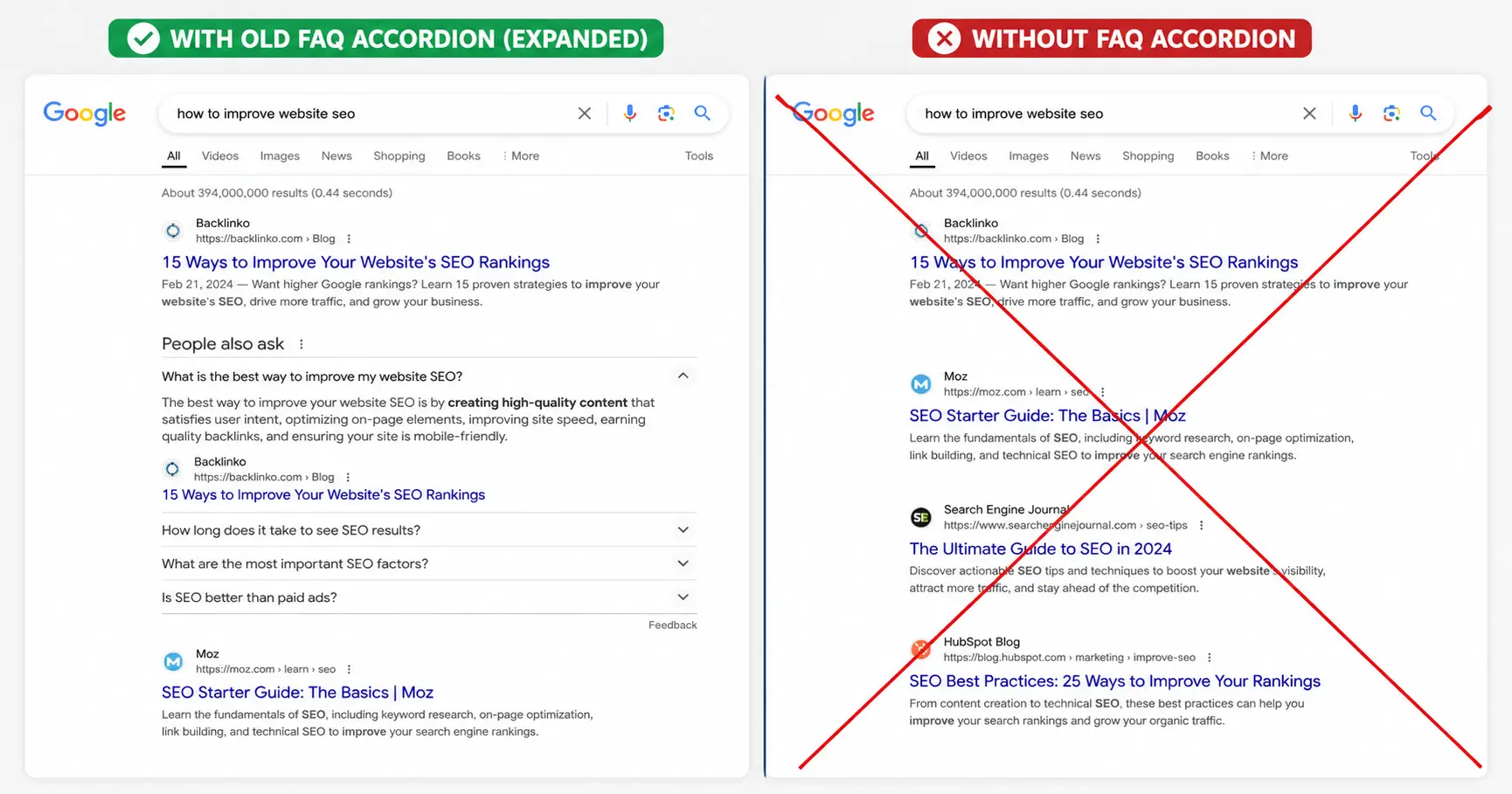
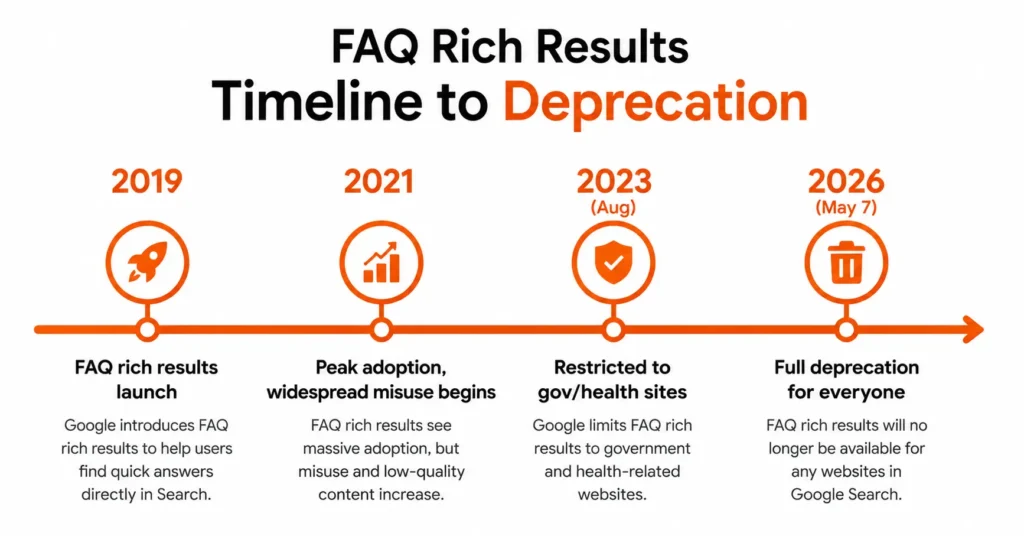
Google launched FAQ rich results in 2019. The premise was simple: if your page answered a list of questions, you could mark it up with FAQPage schema, and Google would reward you with expandable accordion dropdowns right in the search results — more SERP real estate, higher click-through rates, a clear competitive edge.
The SEO community pounced. Within two years, FAQ sections were being bolted onto blog posts, landing pages, product pages, and service pages — not because users needed them, but because the schema was an easy win. Questions stuffed with keywords. Answers copy-pasted from the body content. Whole sections that existed purely to occupy pixels on a results page.
Google eventually had enough. In August 2023, John Mueller announced that FAQ rich results would be restricted to well-known, authoritative government and health websites — effectively pulling the feature for the vast majority of sites overnight.
Most businesses lost their FAQ snippets then. But the complete shutdown — covering even the government and health sites that had retained it — came on May 7, 2026.
What the Google FAQ Rich Results 2026 Update Actually Changed
Let’s be precise, because the industry is already doing what it always does — overreacting in two opposite directions at once.
Here is the actual removal timeline, straight from Google’s documentation:
May 7, 2026 — FAQ rich results stop appearing in Google Search for all websites, including government and health domains that had retained them since 2023. The visual SERP feature — the expandable accordion dropdowns — is gone.
June 2026 — Google removes the FAQ search appearance filter, the FAQ rich result report in Search Console, and Rich Results Test support for FAQ markup. If your team relies on the Rich Results Test for FAQ validation, that workflow dies in June.
August 2026 — Support for the FAQ rich result in the Search Console API is removed. Any automated dashboards or BigQuery pipelines pulling FAQ rich result data will start silently failing if you haven’t updated them.
What Google did not do is deprecate the FAQPage schema type itself. Google’s documentation is explicit: it will continue to use FAQ structured data to better understand pages, even though it will no longer display the rich result. The schema lives on. The SERP feature doesn’t.
That distinction matters more than most coverage of this story suggests.
The Reaction Most SEOs Are Getting Wrong
Two camps formed within 48 hours of the announcement.
Camp One: “Schema is dead. Remove it all. Stop wasting time on structured data.”
Camp Two: “FAQ schema is more important than ever now — it’s the key to AI Overview citations!”
Both are wrong. And both are the kind of confident, zero-nuance hot takes that make SEO Twitter exhausting.
The truth is more boring and more actionable.
Google’s own statement is that structured data — including FAQPage markup — continues to function as a comprehension signal. That means when Google crawls your page, well-formed FAQ schema still helps its systems understand the relationship between your questions and answers. It still contributes to how clearly Google can parse your content. What it no longer does is trigger a visual SERP feature.
On the AI side, a May 2026 Ahrefs study of 1,885 pages that added JSON-LD schema markup between August 2025 and March 2026 found that schema addition produced no statistically significant lift in AI Mode citations (+2.4%) or ChatGPT citations (+2.2%), and actually showed a slight negative correlation with Google AI Overview citations (-4.6%). That last number is surprising, but the broader point stands: schema markup alone is not an AI citation lever. Content quality, structure, and topical authority are doing the heavy lifting.
So before you either tear out all your FAQ markup or pivot your entire content strategy to “AI schema optimisation,” read the next section carefully.
What You Should Actually Do: A Practical Checklist
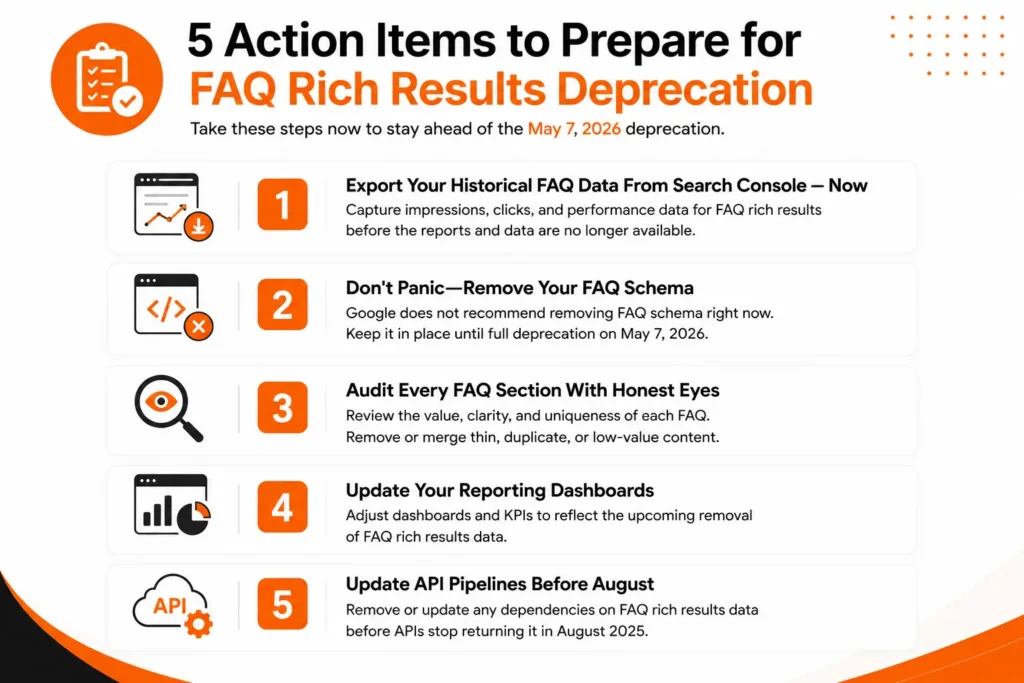
1. Export Your Historical FAQ Data From Search Console — Now
This is the most time-sensitive action item. Once Google removes the FAQ rich result report in June 2026, that historical performance data is gone. Before June, go into Search Console, filter by FAQ search appearance, and export the impression and click data for every affected page. You’ll need this baseline if you want to measure the actual traffic impact of the deprecation over the coming months.
2. Don’t Panic-Remove Your FAQ Schema
If your FAQ markup is accurate, matches the visible content on the page, and the questions genuinely help users — leave it. The schema causes no errors, no ranking penalties. Other search engines, including Bing, continue to process it. And even Google explicitly states it still reads the markup for page comprehension purposes.
Remove it only if the FAQ section was thin, keyword-stuffed, or exists purely as a remnant of the rich result era with no real user value.
3. Audit Every FAQ Section With Honest Eyes
This update is an excellent forcing function to ask the question you probably should have asked years ago: Does this FAQ section actually help someone, or did we add it for SEO?
Go through your highest-traffic pages. For each FAQ block, ask: would a real user landing on this page be better served by this section? If yes, keep it — and keep the schema. If the answer is no, remove the section entirely or rewrite it as part of the body content where it actually belongs.
4. Update Your Reporting Dashboards
Any dashboard that tracks FAQ rich result performance as a metric needs to be updated now. Stop reporting on it as a current opportunity. Replace it with page-level metrics: clicks, impressions, CTR, and average position for the pages that previously carried FAQ snippets. Run a 28-day before-and-after comparison for those pages starting from May 7. Be patient — it takes 6 to 12 weeks for traffic patterns to stabilise after a SERP change like this.
5. Update API Pipelines Before August
If your team runs automated reporting through the Search Console API and pulls FAQ rich result data, you have until August 2026 to update those calls. After August, the API support is gone. Silent failures in downstream reports are the worst kind — schedule this work now, not in July.
The Bigger Picture: What This Actually Tells You About Search in 2026
This is where the FAQ deprecation becomes genuinely interesting, and genuinely instructive.
Google has been pruning its rich result ecosystem for years. HowTo rich results were deprecated for desktop in 2024. Product review snippets were tightened. Sitelinks search boxes were pulled. Book actions, claim reviews, event-based markups — gone. Each time, the pattern is the same: a feature gets widely adopted, gets abused, loses its signal-to-noise value, and gets removed.
The FAQ rich result is just the latest casualty of that cycle.
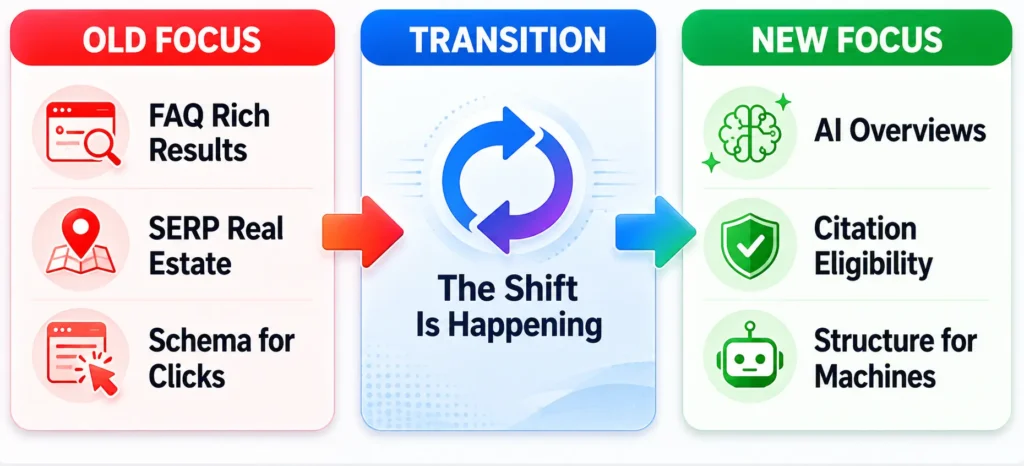
But what’s replacing these SERP features isn’t nothing. It’s AI Overviews. And the rules for appearing in an AI-generated answer are fundamentally different from the rules for earning a structured data rich result.
Here’s what the data looks like right now.
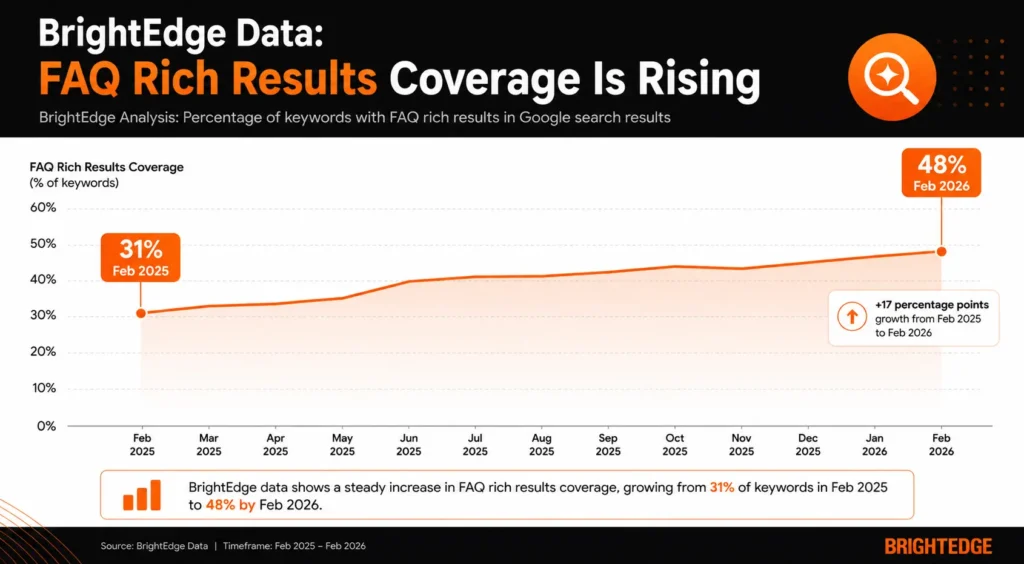
BrightEdge data tracked from February 2025 to February 2026 shows AI Overviews grew from appearing on 31% of tracked queries to 48%. That’s nearly half of all Google searches now returning an AI-generated answer above the traditional blue links.
An Ahrefs study of 300,000 keywords found that position one organic CTR drops 58% when an AI Overview is present. For every 100 clicks a top-ranking page used to earn, AI is keeping 58 of them. And only 38% of pages cited in AI Overviews rank in the traditional top 10 — down from 76% in mid-2025. Ranking authority and citation eligibility are decoupling.
AI-referred sessions to websites grew 527% between January and May 2025. That is not a gradual trend. That is a tectonic shift in how users discover information online.
The implication is stark: the channels through which your content reaches people are being rewired in real time, and FAQ rich results were one casualty of that rewiring. They were a visual feature built for a search experience that is shrinking. What’s growing is a system that reads your content, extracts answers, synthesises responses, and cites its sources — sometimes without a user ever clicking through to your site.
That’s a different game entirely. And it requires a different content strategy.
This shift connects directly to how AI is changing digital marketing today — search is no longer just about ranking, it is about being cited.
Google Search Console FAQ rich result report
What Actually Gets You Cited in AI Answers
Since the data shows schema alone isn’t the lever, what is?
Clear answer-first structure. AI systems extract discrete, citable claims from pages. Content that buries the answer under three paragraphs of context is harder to extract from. Put the direct answer in the first 30 to 60 words of each section. Make it easy for a machine to pull out a complete, accurate statement.
Topical authority and depth. AI Overviews heavily favour pages that demonstrate deep coverage of a subject, not pages that mention a topic in passing. A comprehensive guide that properly answers related questions will outperform a shallow page with perfect FAQ schema.
E-E-A-T signals. Author pages, organisation schema, clear bylines, citations to primary sources, and external mentions of your brand all contribute to the trust signals that AI retrieval systems use when deciding which sources to cite. LinkedIn content, in particular, has become significant — it’s now the top-cited domain for professional queries across most AI platforms, with citation frequency doubling between November 2025 and February 2026.
Fresh, accurate content. Research across 17 million AI citations found that AI-surfaced URLs are 25.7% fresher than traditional search results. Answer engines weight recency meaningfully. Stale content — even well-structured stale content — loses citation chances over time.
Genuine FAQ sections (when they’re genuine). Here’s the nuance that the “FAQ schema is dead” camp is missing: pages with FAQPage markup show a 41% citation rate in AI-generated answers versus 15% for pages without it, according to Relixir’s analysis of 50 sites. But the question is causality — are those pages being cited because of the schema, or because they’re well-written, clearly structured pages that happen to also use schema? The Ahrefs study suggests it’s the latter. The content quality that motivates good FAQ markup is what earns citations. The markup is a side effect of the right approach, not the cause of it.
Clear structure is not just an AI signal — it also eliminates the conversion killers hurting your website when users actually land on your page.
Google FAQ structured data official documentation
A Note for Development and SEO Teams
If you’re managing this transition technically, here are the practical changes to make:
Rich Results Test workflows: FAQ validation in the Rich Results Test goes away in June. Update QA checklists now. Replace the “will this trigger the FAQ dropdown?” gate with general structured data validation — schema accuracy, content matches visible text, no spammy Q&A pairs.
Content templates and briefs: If your content brief template still says “add FAQ schema for rich results,” that instruction is out of date. The updated version is: “Add FAQ sections only when they improve the reader’s understanding or help answer a genuine follow-up question. Add FAQPage markup when the section is visible, accurate, and well-structured.”
WordPress and CMS plugins: Many CMS plugins automatically add FAQ schema when FAQ blocks are used. Audit your plugin settings. You don’t need to turn off FAQ schema generation — but ensure it’s only firing on pages with real FAQ content, not auto-applying across templates where no FAQ section exists.
Conclusion: The Lesson Behind All of This
Every time Google removes a rich result feature, the SEO industry goes through the same cycle: confusion, overreaction, consensus, adaptation. The FAQ deprecation will follow the same arc.
But there’s a more durable lesson underneath the cycle, and it’s one that the best content teams already know.
FAQ rich results worked — briefly — because they rewarded pages that clearly answered user questions in a structured way. Then they got gamed. The feature died. But the underlying principle, that clear, structured, genuinely useful answers earn visibility, didn’t die. It never does. It just migrated to the next mechanism: first featured snippets, then FAQ snippets, now AI Overviews and answer engine citations.
The teams that will win in the next phase of search aren’t the ones who mastered FAQ schema. They’re the ones who internalised why FAQ schema briefly worked — and built content strategies around the principle, not the tactic.
Build content that machines can parse and humans actually need. That’s the brief. It has been the brief for a long time. It will keep being the brief long after the next feature gets deprecated.