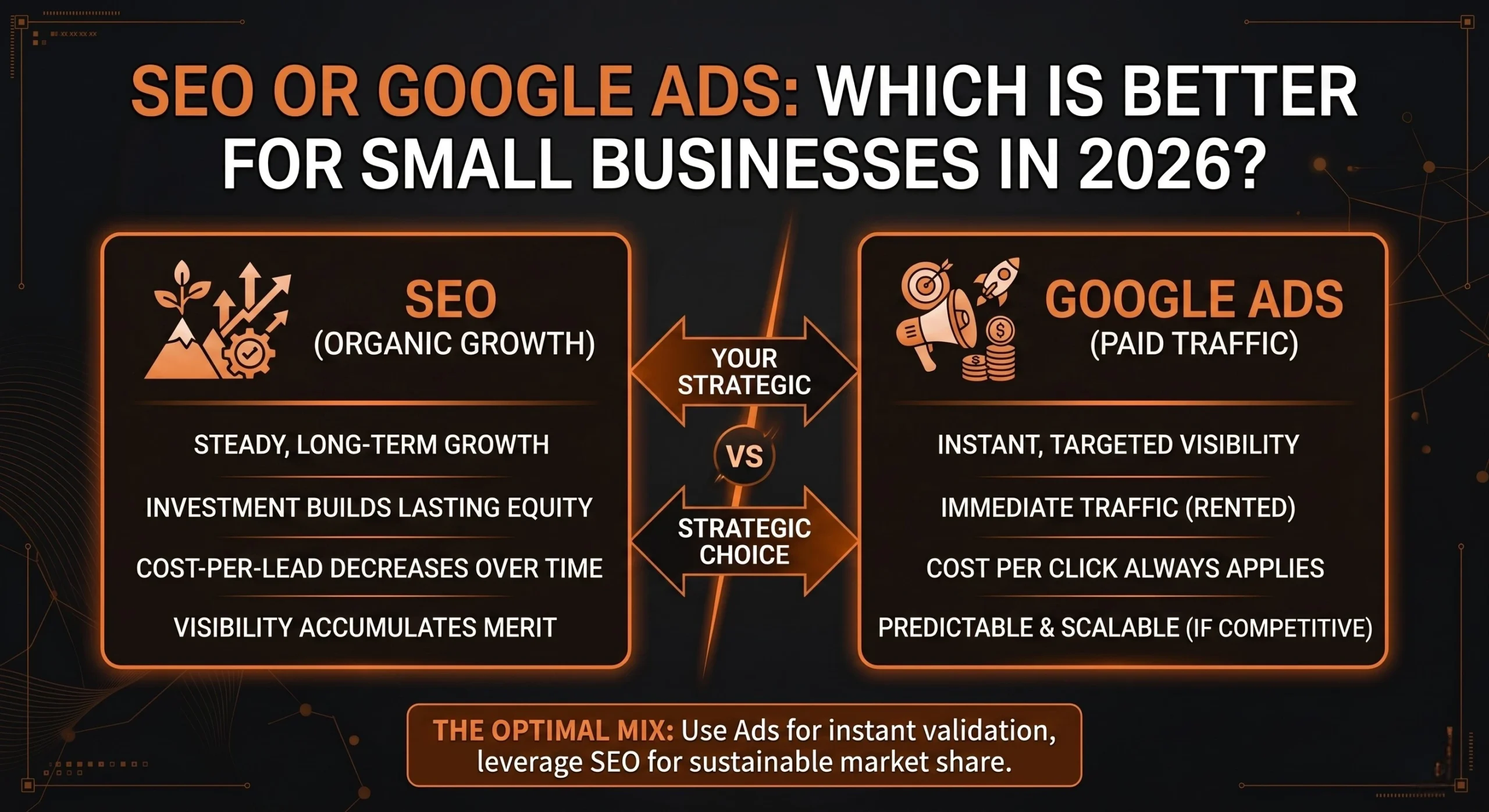
Let’s be honest — if you’re running a small business, your marketing budget isn’t unlimited. Every rupee or dollar you spend needs to work hard. And when it comes to getting found online, you’ve probably heard two things over and over again: do SEO and run Google Ads.
But when it comes to SEO vs Google Ads for small businesses, which one should you actually focus on in 2026?
This isn’t a theoretical debate. We’re going to walk through this practically — with real numbers, realistic timelines, and honest trade-offs — so you can make the right call for your business, not some Fortune 500 company.
Let’s dig in.
Table of Contents
SEO vs Google Ads for Small Businesses: What Are We Actually Comparing?
Before we get into the head-to-head, it’s worth making sure we’re on the same page about what each of these actually means.
SEO (Search Engine Optimization) is the process of making your website appear in Google’s organic (unpaid) search results. When someone searches “best bakery in Lucknow” and your website shows up without you paying Google for that click — that’s SEO working.
Google Ads (formerly Google AdWords) is Google’s paid advertising platform. You bid on keywords, write ads, and pay Google every time someone clicks. Your ad appears at the top of search results, clearly labeled as “Sponsored.”
Both put you in front of people who are actively searching for what you offer. The difference is how you get there — and what that costs you over time.
The Real Difference: Renting vs. Owning
Here’s the simplest way to think about this:
Google Ads is like renting a shop in a prime location. The moment you pay rent, you’re visible. The moment you stop paying, you disappear. Your traffic is directly tied to your ad spend.
SEO is like building your own shop in that same location. It takes time and investment upfront. But once it’s built, it keeps generating foot traffic — even when you’re asleep, even if you reduce your marketing spend for a month.
This single distinction shapes almost every decision a small business owner needs to make about where to invest their marketing money.
Timeline: When Will You See Results?
![Graph comparing SEO organic traffic growth vs Google Ads paid traffic over time]](https://witnexa.com/wp-content/uploads/2026/06/Graph-comparing-SEO-organic-traffic-growth-vs-Google-Ads-paid-traffic-over-time-1024x559.webp)
This is usually the first question business owners ask — and rightfully so.
With Google Ads, results are almost immediate. Once your campaign is approved (usually within a few hours), your ad starts showing. You could get your first website visitors the same day you launch. For a new business that needs customers now, this is genuinely attractive.
With SEO, the reality is slower — but the payoff is compounding. Most SEO experts suggest that meaningful organic rankings take anywhere from 3 to 6 months for competitive keywords. For less competitive, local, or niche terms, you might see traction in 6 to 12 weeks.
But here’s what most people don’t talk about: SEO results don’t plateau the way paid campaigns do. A well-optimized blog post from two years ago can still drive thousands of visitors today. A Google Ad from two years ago? It stopped the moment the budget ran dry.
For small businesses: If you need leads this week, Google Ads wins on timeline. If you’re playing the long game — which most sustainable businesses should be — SEO is the smarter investment.
Visibility: Where Do You Actually Appear?
Open Google right now and search for anything. You’ll notice a few things:
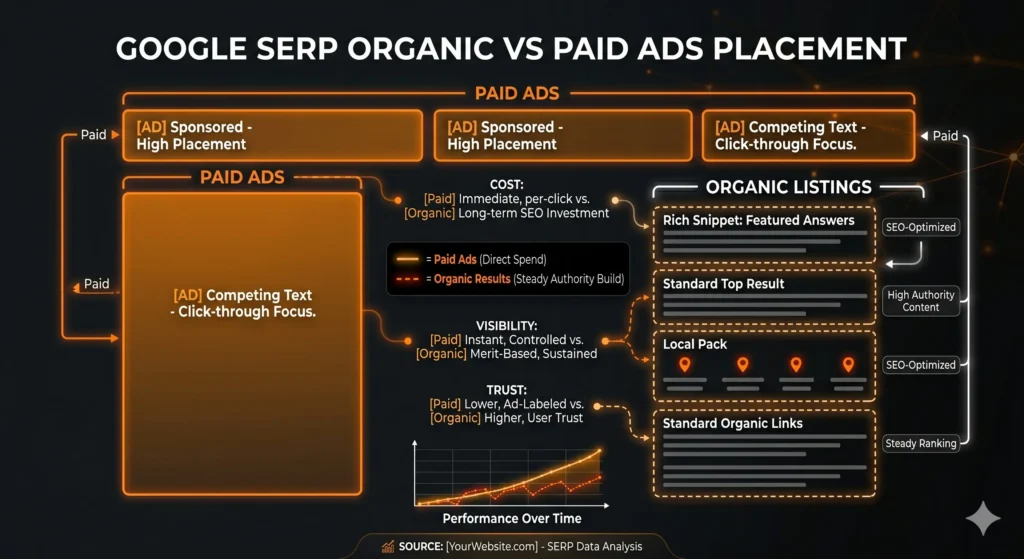
The top 2–4 results are labeled “Sponsored” — those are Google Ads. Below them are the organic results — those come from SEO. There’s often a People Also Ask box, a map pack (for local searches), and featured snippets.
Google Ads gives you premium real estate right at the top of the page. Studies consistently show that top positions get the most clicks.
However — and this is important — users are increasingly aware of and skeptical of ads. Multiple studies show that a significant portion of users deliberately skip past sponsored results and trust organic listings more. Organic results are perceived as more credible because Google’s algorithm, not a paid bid, placed them there.
For local searches like “dentist near me” or “plumber in Delhi,” the Google Maps Local Pack often dominates — and that’s driven by local SEO, not Google Ads.
Cost: What Does Each Actually Cost?
This is where things get real — especially for small businesses with tight budgets.
Google Ads Costs
Google Ads operates on a Cost Per Click (CPC) model — you pay every time someone clicks your ad. And CPC varies wildly by industry.
According to industry benchmarks, average CPCs in 2025–2026 range from:
₹8–₹25 per click for low-competition local services ₹50–₹200 per click for competitive sectors like legal, finance, and healthcare ₹15–₹80 per click for e-commerce and retail
Average Google Ads cost per click by industry
For a small business spending ₹15,000/month on Google Ads, you might get anywhere from 200 to 1,500 clicks — depending entirely on your industry and keyword competition. And when that budget stops, so does everything else.
There’s also the learning curve cost. If you’re managing Google Ads yourself without experience, it’s very easy to waste 30–40% of your budget on poorly targeted keywords, bad match types, or weak ad copy before you figure out what works.
SEO Costs
SEO isn’t free — but the cost structure is completely different.
DIY SEO: If you’re doing it yourself, the primary cost is time. You’ll also pay for tools like Rank Math Pro (₹3,000–₹8,000/year), Ahrefs or Semrush (₹8,000–₹25,000/month), and hosting and speed optimizations.
Hiring an SEO agency or freelancer: In India, a decent SEO professional charges ₹10,000–₹35,000/month for small business SEO. In Western markets, this ranges from $500–$2,500/month.
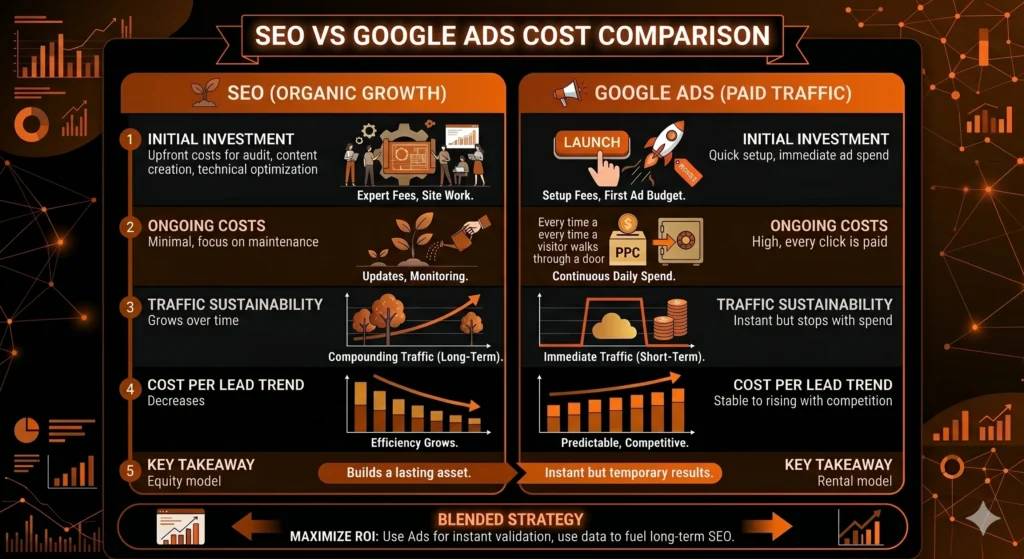
The crucial difference is that SEO investment compounds. A well-optimized page can generate traffic for years with minimal ongoing cost. Over a 24-month period, organic traffic from SEO typically becomes dramatically cheaper per visitor than paid traffic.
How to track ROI from digital marketing
ROI: Where Does Your Money Go Further?
Let’s talk about return on investment — the number that actually matters.
Google Ads ROI is more immediate but also more fragile. If your conversion rate is solid and your offer is good, paid ads can deliver a positive ROI quickly. But you’re in a constant arms race with competitors bidding on the same keywords. Costs tend to rise over time. And the moment you stop spending, your ROI drops to zero.
SEO ROI takes longer to materialize but tends to be far stronger over time. Multiple marketing studies have consistently shown that inbound leads from organic search cost significantly less than outbound leads from paid channels — over a sustained period.
Here’s a realistic comparison for a small business:
Monthly Cost | Google Ads Month 1: ₹20,000 | SEO Month 1: ₹15,000 | SEO Month 12: ₹15,000 Monthly Visitors | Google Ads: 400–800 | SEO Month 1: 0–100 | SEO Month 12: 800–3,000+ Cost Per Visitor | Google Ads: ₹25–₹50 | SEO Month 1: Very high | SEO Month 12: ₹5–₹18 Traffic if Budget Stops | Google Ads: Zero | SEO: Continues | SEO: Continues Brand Authority Built | Google Ads: None | SEO Month 1: Growing | SEO Month 12: Significant
The numbers make a compelling case: for long-term ROI, SEO wins decisively. But in the short term, Google Ads can bridge the gap.
This is why the SEO vs Google Ads debate for small businesses almost always ends the same way — SEO wins on long-term value, Ads win on short-term speed.
When Google Ads Makes More Sense for Small Businesses
Let’s be fair — there are absolutely scenarios where Google Ads is the smarter choice:
You just launched and need leads immediately. A new bakery, consultancy, or service business can’t wait 6 months for SEO to kick in. Google Ads puts you in front of buyers right now.
You’re running a time-sensitive promotion. A seasonal sale, an event, or a limited-time offer is perfect for paid ads. You can turn it on and off at will.
Your product has very high margins. If you’re selling high-ticket services like legal, financial, or real estate, even a high CPC can deliver a strong ROI because each customer is worth a lot.
You’re testing a new market. Before investing heavily in SEO content for a new audience, Google Ads can quickly tell you whether that audience converts.
You’re targeting very specific, high-intent keywords. Searches like “emergency plumber Noida” or “wedding photographer book now” signal someone ready to pay. Ads can capture that intent instantly.
Need to set up Google Ads on a small budget
When SEO Makes More Sense for Small Businesses
SEO is the right long-term foundation for most small businesses. Here’s when to lean into it:
You’re building a brand for the long haul. Organic visibility builds trust in a way paid ads never can. People trust Google’s organic results more than sponsored placements.
You’re in a local service business. Local SEO — optimizing your Google Business Profile, getting local citations, collecting reviews — is one of the highest-ROI activities for any local business. And it’s largely free to start.
You have a content-rich business. If you run a blog, educational site, SaaS tool, or consulting practice, SEO and content marketing go hand in hand. Every piece of content becomes a long-term traffic asset.
You want to reduce dependence on paid channels. Businesses that rely 100% on Google Ads are one budget cut or one algorithm shift away from losing all their traffic. SEO builds resilience.
Your competitors aren’t doing SEO well. In many local or niche markets, the SEO competition is surprisingly weak. A few months of consistent effort can put you at the top of organic results in a relatively short time.
The Honest Answer: It’s Not Either/Or
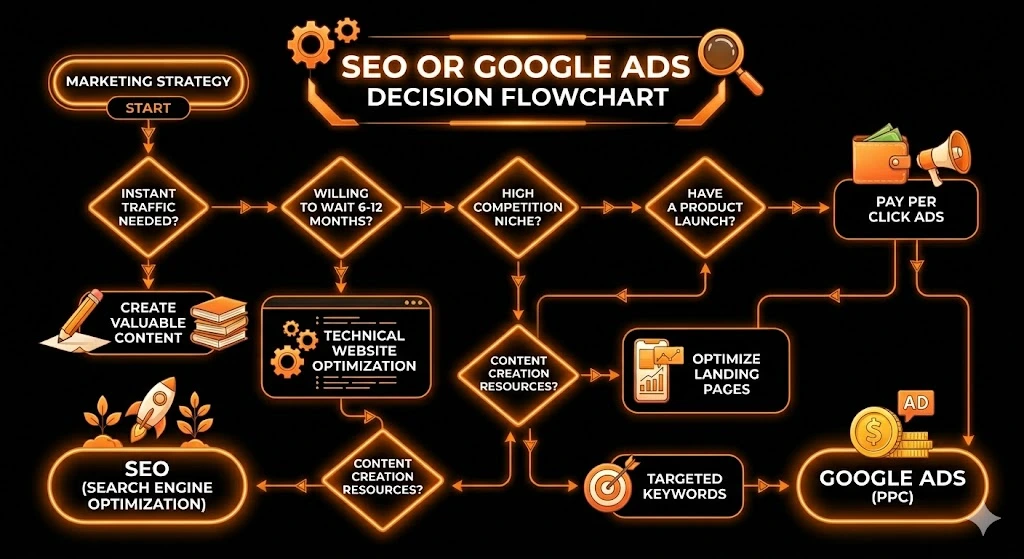
Here’s the truth that most comparison articles dodge: for most small businesses, the ideal strategy in 2026 is both — just sequenced smartly.
Think of it this way:
Phase 1 (Month 1–3): Run Google Ads to get immediate traffic and leads while you start building your SEO foundation.
Phase 2 (Month 3–9): As your SEO starts generating organic traffic, gradually reduce your Ads budget for keywords where you’re now ranking organically.
Phase 3 (Month 9+): Reinvest the savings from reduced ad spend into more SEO content and link building. Your organic traffic compounds while your ad costs drop.
This approach means you’re never starved for traffic in the early days, but you’re also not trapped in a forever-pay-to-play model.
If you have ₹30,000/month for digital marketing:
Tight budget scenario: Spend ₹5,000–₹10,000 on targeted Google Ads for your top 3–5 conversion keywords, put the rest into SEO.
Growth scenario: Equal 50/50 split early, then gradually shift more toward SEO as you build authority.
What’s Changed in 2026 That You Need to Know
The SEO vs. Google Ads conversation in 2026 has a few new wrinkles worth understanding:
AI Overviews in Search Results: Google’s AI-generated summaries now appear at the top of many search results. This has changed click patterns — some informational queries get answered directly in the SERP without anyone clicking through. This is a reason to focus more on commercial and transactional SEO, and to use Google Ads for high-intent buying keywords.
Smart Bidding Has Improved: Google’s machine learning-based bidding strategies like Target CPA and Target ROAS have gotten genuinely good. Small businesses that struggled with manual bidding in the past can now run leaner, more efficient campaigns.
Google Business Profile Is More Powerful Than Ever: For local service businesses, your Google Business Profile — which is part of local SEO — often gets more SERP visibility than paid ads. And it’s free to set up.
Core Web Vitals Still Matter: Technical SEO factors like page speed, mobile usability, and Core Web Vitals remain important ranking signals. A slow website hurts your organic rankings — and also your Google Ads Quality Score, which directly affects how much you pay per click.
How Google’s search algorithm works
5 Questions to Help You Decide Right Now
Still unsure? Answer these five questions honestly:
How urgently do you need leads? If you need customers this week — start with Google Ads. If you can wait 3–6 months for compounding growth — prioritize SEO.
What’s your monthly marketing budget? Under ₹10,000? Google Ads gets very competitive at low budgets in most industries. SEO may be more cost-effective. Over ₹25,000? You can comfortably do both.
Do you have content on your website? If your site has fewer than 10 pages and no blog, SEO will take longer because you have less to work with. Google Ads can drive traffic without content.
Are you a local business? If yes, local SEO is almost always worth doing before Google Ads. Your Google Business Profile alone can drive significant traffic at zero cost.
What do your competitors rank for? Run a quick competitive analysis. If your top competitors rank organically for your target keywords, that’s where the trusted traffic lives. You want to be there too — not just in the ad slots above them.
Conclusion: Think Long-Term, Act Immediately
If you take one thing from this article, let it be this: Google Ads wins the short game, SEO wins the long game — and smart small businesses play both.
In 2026, the businesses that will dominate their local markets and niches aren’t the ones spending the most on ads. They’re the ones that have patiently built organic authority while using paid ads strategically to fill short-term gaps.
Google Ads is a powerful tool — but it’s an expense. SEO is an investment that builds an asset: your website’s authority and long-term visibility. And in the long run, assets beat expenses every single time.
Start where your budget and timeline allow. But always keep your eyes on the bigger prize: owning your search visibility, not renting it.
FAQ’S
Is SEO free?
SEO is not free — it requires time, tools, and often professional help. But unlike Google Ads, you don’t pay for each visitor. Over time, the cost per visitor from organic traffic is significantly lower than paid traffic.
Can a small business do SEO on its own?
Yes — especially local SEO. Optimizing your Google Business Profile, getting customer reviews, and publishing helpful content are things any business owner can do. Technical SEO is more complex and may need professional help.
How much should a small business spend on Google Ads?
Most experts recommend a minimum of ₹10,000–₹20,000/month to see meaningful results in competitive markets. Below that, your budget may not generate enough data to optimize effectively.
Does running Google Ads help your SEO rankings
No. Google has confirmed that ad spend does not influence organic rankings. However, Ads can help you identify which keywords convert well — useful data you can then apply to your SEO strategy.
Which is better for a new business — SEO or Google Ads?
For a brand new business, a combination usually works best: Google Ads for immediate visibility and leads, while you build your SEO foundation in the background. As your organic presence grows, you can gradually rely less on paid ads.